

You have your visa. You have your flight. Now the real work starts. The first weeks in Germany decide how smooth the rest of your stay will be. This guide covers the four things students ask about most after arrival. Dorms and rooms. Anmeldung. Student jobs. And the road to PR. It is free to read. No agency is needed for this part. If you have not read the visa guide yet, start there. It explains the blocked account and the CSP portal. Read it here: German Student Visa and Blocked Account: A Simple Guide for Bangladeshi Students at https://studyingermanyhub.com/blog/german-student-visa-blocked-account-bangladesh
First, a short list for week one
Do these in order. Find a safe place to sleep. Do Anmeldung. Open a bank account. Sort health insurance. Enrol at your university. Then look for work. Do not try to do all of it on day one. But do not put Anmeldung off. It unlocks almost everything else.
Dorms: apply early, and do not wait for one offer
A dorm is the cheapest safe start for most students. The rooms are run by the local Studierendenwerk. That is the student services body for your city. It is not one national office. Each city has its own. So apply to the Studierendenwerk where your university is. You can apply before you enrol. Many students do not know this. In Göttingen, for example, the Studierendenwerk says you can apply without a letter of admission or a certificate of enrolment. You hand in the enrolment proof after you move in. Other cities work the same way in most cases. Check your own Studierendenwerk page. Do not assume. Apply as early as you can. Rooms go by waiting list. The earlier your application arrives, the better your place on the list. Waiting times differ a lot. Some dorms list 6 to 14 months. Some list 12 to 24 months. So a dorm is a plan, not a promise. Apply to the dorm and look for a WG room at the same time. In the groups, students ask the same question again and again. They applied to a dorm weeks ago and got no reply. That is normal. A waiting list is not a rejection. But it is also not a room. Do not delay your flight because you are waiting for a dorm reply. Have a backup plan.
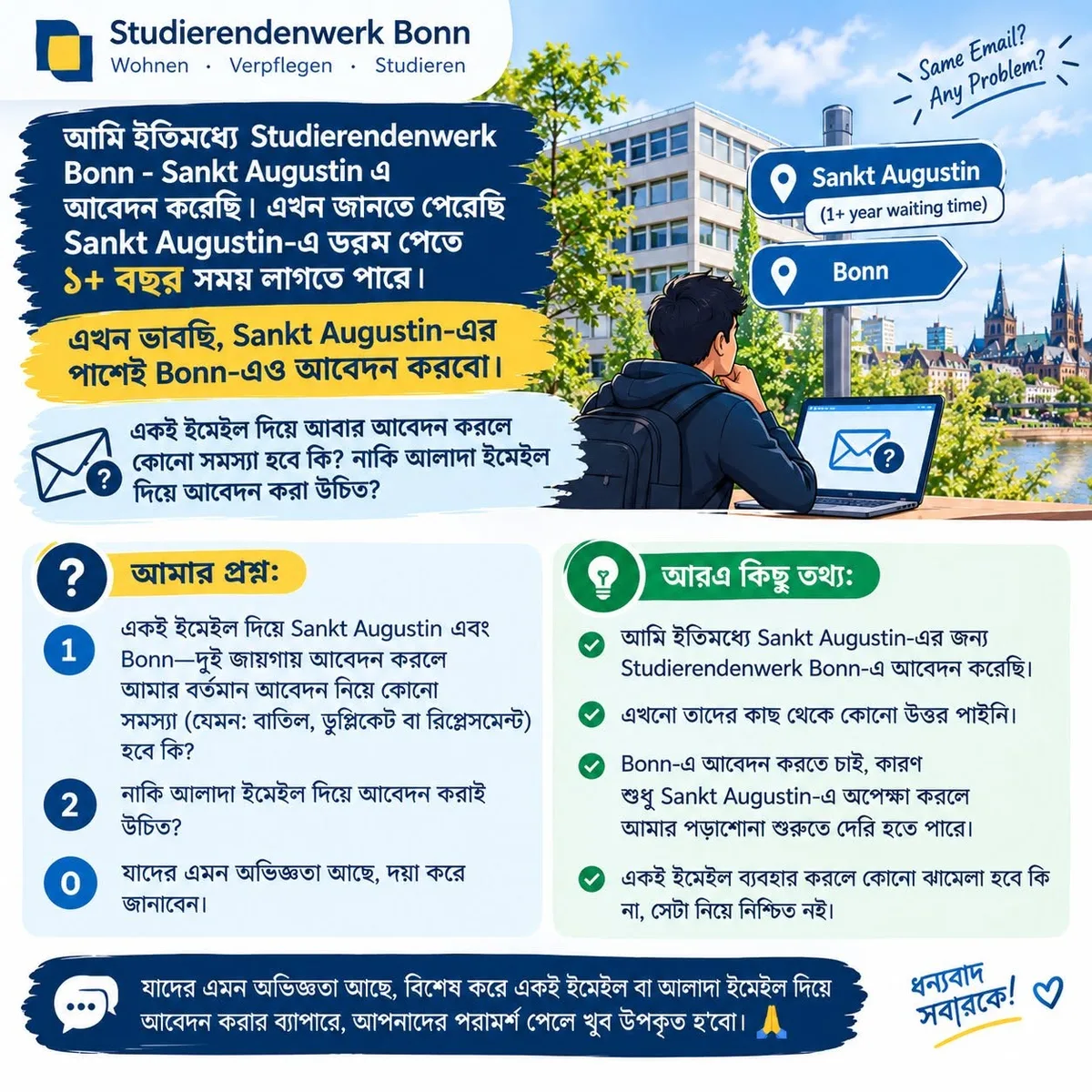
A student asks about a Studierendenwerk dorm application and a waiting time of over a year. Shared by students in the group.
Reference shared by students in the group.
WG rooms: what to check before you pay
A WG is a shared flat. You rent one room. You share the kitchen and bathroom. Most students in Germany live this way. WG-Gesucht is the main site students use to find WG rooms. In the groups, many students say they sent lots of messages there and got no reply. That is common in big cities. Keep trying. Write short, clear messages. Say who you are, when you can move in, and that you are a student. Before you pay any money, check four things. First, can you do Anmeldung there? This is the most important question. In the groups, almost every room post says Anmeldung is required, or Anmeldung is possible, or Anmeldung is not possible. Take that line seriously. If Anmeldung is not possible, do not take the room as your first home. You need Anmeldung for your bank account, your tax ID, your health insurance, and your residence permit. A room without it will block you. Second, what is the warm rent? Warm rent means rent plus heating, water, and other costs. Ask what is in it. Ask about internet. Ask about the deposit. Ask how much you pay to move in, and when you get the deposit back. Third, is the room furnished? Many dorm rooms are furnished. Many WG rooms are not. Ask for photos. Ask what is in the room. A bed, a table, a chair, and a cupboard are the basics. If the room is empty, plan for that cost. Fourth, who is the landlord? Get the rental contract in writing. Get the landlord confirmation form signed. That form is called the Wohnungsgeberbestätigung. You need it for Anmeldung. Do not pay a deposit to a stranger without a contract and without seeing the room on video call at least. Rent in the group posts varies a lot by city. Students in the posts look for rooms from about 250 to 450 euro a month. Small cities are often cheaper. Big cities are often dearer. Those are group examples, not a price promise. Your city page on this site can help you compare rents by city.
Couples and families: ask first
Students who move as a couple ask about couple rooms and couple dorms. Some dorms have flats for two people. Many do not. Ask the Studierendenwerk directly. Do not assume a single room can hold two people. Space rules and the rental contract decide this, not the group. If you are married, keep your marriage papers ready. Students ask whether to say married at Anmeldung when the passport or visa does not say so. The safe rule is simple. Give the true facts. Bring the marriage certificate and a German translation if the office asks for it. Ask the Bürgeramt what it needs. Do not guess at the desk.
Anmeldung: do it within 14 days
Anmeldung means city registration. You register your address at the local Bürgeramt. That is the citizens office. It is also called the Einwohnermeldeamt in some cities. It is a legal duty. You must do it within 14 days of moving in. The clock starts when you move in, not when you land at the airport. Without Anmeldung, you cannot do much. You cannot open a German bank account. You cannot get your tax ID. You cannot apply for your residence permit. So book the appointment as soon as you have an address. In the groups, students say they arrived on 1 October and got a slot only at the end of the month. That happens in big cities. Book the slot the day you have an address. If the slot is late, keep the booking. Do not miss it. Ask the office if a walk in is possible in a small city. In most big cities, you need an online appointment. Bring these to the appointment. Your passport in original. The filled Anmeldung form. The Wohnungsgeberbestätigung, signed by your landlord. Your rental contract helps too. Bring it even if the office does not ask for it. The registration itself is free. You get a paper called the Meldebescheinigung at the appointment. Keep it safe. You will need it again and again. If you move to a new flat in Germany, you register again. That is called Ummeldung. If you leave Germany for good, you deregister. That is called Abmeldung. Keep the dates straight.
An infographic shared in the group explains what city registration (Anmeldung) is and why it comes first after arrival.
Reference shared by students in the group.
Money after arrival: your blocked account pays monthly
Your blocked account pays you 992 euro each month after you arrive and register. That is the amount in the visa guide. It is not a full budget for every city. Rent takes a big share. So plan the first month with care. Open a German bank account soon after Anmeldung. You need the Meldebescheinigung for it in most cases. Keep the transfer receipt from Bangladesh. Keep your bank statements. The foreigners office may ask for proof of funds when you extend your residence permit in year two. Students in the groups ask whether a part time job contract can replace a second year blocked account. The answer is not simple. It depends on your city office and your case. Ask your Ausländerbehörde early. Do not assume a job contract is enough. If you leave Germany without Anmeldung and without unblocking your account, the money can get stuck. Students in the groups have asked about this. If you plan to leave, ask your blocked account provider how to close the account and get a refund before you fly. Do it in writing. Keep the reply.
Student jobs: know the day limit
Students from outside the EU can work up to 140 full days or 280 half days per year. A day with up to 4 hours of work counts as a half day, and a day with more than 4 hours of work counts as a full day. You can work freelance or be self employed only as a side job, and you may need permission from the foreigners office first, so check your permit and ask the office before you start. Keep a record of every day you work. The foreigners office can ask for proof. Student assistant jobs at your university are different. These are called Hiwi jobs. They do not count toward the 140 day limit. A mandatory internship for your degree also does not count. A voluntary internship does count. Check your own residence permit. The limit printed on it is the one that counts for you. You can also count your work by the week instead, and work up to 20 hours a week during the semester. Note: the limit rose to 140 full days or 280 half days on 1 March 2024. Check your permit. The limit printed on it is the one that counts for you. There are three common kinds of student work. First, warehouse and shop jobs. DHL, Amazon, REWE, and similar firms hire students for shifts. Students in the groups ask about DHL warehouse work for women, and about Amazon warehouse appointments. These jobs pay by the hour and fit around classes in many cases. They are physical work. Ask about shift times, travel time, and rest days before you sign. Second, Werkstudent jobs. Werkstudent means working student. You work part time in a firm in your own subject. It is the best kind of student job for your CV. It can lead to a thesis topic or a full time job after graduation. But it is competitive. Most adverts ask for at least B1 German. Some ask for more. Start early. It can take about three months from application to start. Use LinkedIn, Indeed, Xing, and StepStone. Write a short CV for each job. Do not copy one CV for all jobs. Third, Hiwi jobs at your university. These are student assistant jobs. You help a professor, a lab, or a department. Ask your department office. Ask your professors. These jobs are close to campus and close to your subject. They are hard to get, but they are worth trying for. German is the key. Students in the groups say again and again that jobs are easier with German. Even B1 opens many doors. A1 is not enough for most Werkstudent jobs. If you can, learn German before you fly. If you cannot, start a course in your first semester. Health insurance and work: students in the groups ask whether private health insurance stops them from working in a warehouse. This guide does not give a yes or no. Ask the employer and ask your insurer before you sign a contract. If you start a job that pays social security, your insurance status can change. Check that with the insurer, not with a group post.

A group infographic asks whether a HiWi job and a Minijob can be combined while studying in Germany.
Reference shared by students in the group.
After graduation: 18 months to find a job
When you finish your degree, you can apply for a residence permit to look for a job. It lasts up to 18 months. During that time, you can take any work to support yourself while you look for a job that fits your degree. Apply before your student permit ends. Bring your degree certificate, your passport, proof of health insurance, and proof of funds. Your local Ausländerbehörde can tell you the exact list. If you find a job that fits your degree, you can switch to a work permit. If you do not find one in 18 months, you must leave. That is the rule. So start the job search before you graduate. Use your Werkstudent job, your thesis, and your university career office.
PR: the settlement permit, in plain words
PR in Germany means a settlement permit. The German name is Niederlassungserlaubnis. It is permanent residence. It is not a visa. It is not automatic. And no one can promise it to you. The rules are in the Residence Act. They depend on your permit, your job, your German, and your pension payments. Here are the main routes, in short. The standard route needs 5 years on a residence permit. It needs 60 months of pension payments. It needs B1 German. It needs a secure income, basic knowledge of German law and life, and a home that is big enough for you and your family. The skilled worker route is faster. If you hold a skilled worker permit, you can apply after 3 years. You need 36 months of pension payments and B1 German. You need a job that your permit allows. If you finished your degree in Germany and now work in a job that fits it, the route is faster again. You can apply after 2 years on a skilled worker permit. You need 24 months of pension payments and B1 German. EU Blue Card holders have their own route. After 27 months of work on a Blue Card, you can apply. With B1 German, the time drops to 21 months. With A1 German, it stays at 27 months. Study time counts in part toward the 5 year total, but the exact credit depends on your case. Do not plan your life on a guess. Ask your Ausländerbehörde. Keep every pension slip. Keep every job contract. Learn German to B1 at least. Those three habits matter more than any shortcut. Do not pay an agent who promises PR in a fixed time. PR depends on the law and on your own record. No agent can change that.
A simple plan for year one
Month one: Anmeldung, bank account, health insurance, enrolment. Month two: settle in, learn the bus and train, start German classes. Month three: look for a Hiwi job or a Werkstudent job. Keep your work days counted. Keep your grades up. Your grades decide your next permit, not your job. Before each semester, check your residence permit date. Apply for an extension early. Bring your transcript, your enrolment proof, your health insurance, and your proof of funds. Do not wait until the last week.
Checklist and mistakes
Before you fly, check: dorm application sent, WG search started, Anmeldung documents packed, passport and visa ready, blocked account proof saved, health insurance proof saved, enrolment letter saved, German course booked if you can. The mistakes that cost students most: waiting for a dorm reply and having no backup room, taking a room without Anmeldung, missing the 14 day Anmeldung deadline, working past the day limit, trusting a group post over your own residence permit, and paying an agent for basic facts. The city office, the Studierendenwerk, the DAAD, and Make it in Germany are free. Read them first. Check the official pages before you act: DAAD at daad.de, Make it in Germany at make-it-in-germany.com, your local Studierendenwerk, and your local Ausländerbehörde.
The minijob limit rose in 2026
The minijob limit was 556 euro a month in 2025. From 1 January 2026 it is 603 euro a month, or 7,236 euro a year. The limit is tied to the minimum wage, which rose to 13.90 euro an hour on the same date. A minijob up to 603 euro a month stays largely free of tax and social contributions for you. Above that, you move into the midijob zone, up to 2,000 euro a month with reduced contributions. The limit is set to rise again to 633 euro in 2027. A contract that pays 600 euro a month fits the minijob rules. A contract that pays 800 euro a month does not.
Your second year needs money proof again
A residence permit is usually given for two years at most, so almost every student extends it once. The office will ask for the same proof as the first time: 992 euro a month, health insurance, and proof that your studies are moving forward. A blocked account is one way to show it. It is not the only way. A part time job contract can replace it, if the pay covers 992 euro a month for the new period. Many offices also accept a mix, such as a Werkstudent salary plus a smaller blocked balance, or bank statements for the last 6 months plus other income. A small minijob alone does not cover it. The final call is made by your own foreigners office, and each city checks in its own way. Apply 8 weeks before your permit ends, and ask the office early if your money comes from a job rather than a blocked account.